
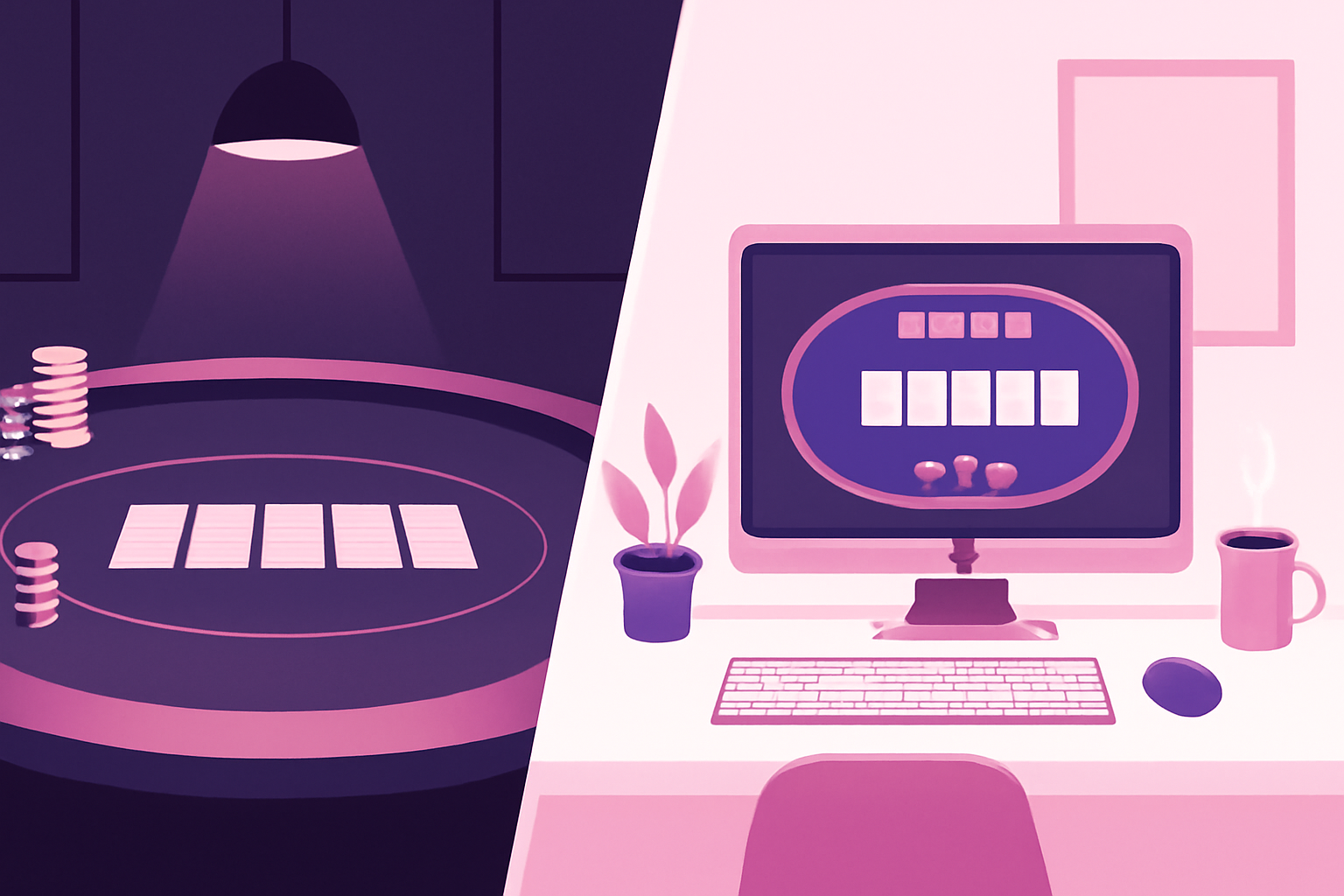
Poker live vs online in 2026: key differences, pros and cons
Discover the biggest differences between live and online poker in 2026. Which format suits your style, bankroll and goals best?
Poker live vs online in 2026: key differences, pros and cons
Whether you're grinding micro-stakes from your couch or shuffling chips at a casino table, poker remains one of the most skill-intensive card games in the world — but *where* you play changes almost everything. In 2026, the gap between live poker and online poker has never been more pronounced, with online platforms offering lightning-fast gameplay and advanced tools, while live cardrooms deliver an irreplaceable human experience. If you're trying to decide which format suits your goals, or you want to dominate both, this guide breaks down the real differences so you can make smarter decisions at the table.
How the two formats actually differ day to day
At first glance, poker is poker — a standard 52-card deck, hand rankings, and the same core rules whether you're in Las Vegas or logged into a platform at midnight. But the day-to-day reality of each format is strikingly different.
Live poker is played physically at a casino or poker room. You handle real cards, stack real chips, and sit across from real opponents. A typical live game of No-Limit Hold'em at $1/$2 stakes will see you play roughly 20–25 hands per hour — a slow burn that demands patience.
Online poker, by contrast, is digital, instant, and relentless. A single table online deals about 70–100 hands per hour, and if you're multi-tabling (playing four, six, or even nine tables simultaneously), you could be making decisions on hundreds of hands every sixty minutes. This compression changes the entire skill set required.
In 2026, online platforms also offer features simply unavailable in live settings: hand histories, HUDs (Heads-Up Displays), solver integrations, and real-time statistics on your opponents. Live players have none of that — but they have physical tells, a dimension of the game that disappears entirely on a screen.
The pros of playing live poker
Live poker has endured for good reason. Here's what it genuinely has going for it.
A deeper read on your opponents
When you're sitting across from someone, you notice the way they fidget before a big bet, how long they tank before calling a river shove, or whether their hands shake when they put chips in. These physical tells are real edges. If your opponent stares at the board after a flush completes and then bets — that hesitation can mean everything.
Imagine you're holding A♠ K♠ on a board of Q♠ 7♠ 2♦. You bet the flop. Your opponent raises. In an online game, you have stats. Live, you notice his jaw tighten. That read might convince you to call down — or fold to a nit. Neither decision is available to you in the same way online.
Softer competition at lower stakes
Live $1/$2 games are notoriously soft. Many players at these stakes are recreational gamblers who don't study the game seriously. Hourly win rates for solid, thinking players can be very high in these environments, even though the volume is low.
Social experience and atmosphere
There's a reason the World Series of Poker still packs the Rio every summer. Live poker is an event. The energy, the conversation, the reads — it's an experience that no home screen replicates.
The pros of playing online poker
Online poker in 2026 has evolved into a sophisticated, data-rich environment that rewards technical precision.
Volume and speed
The sheer number of hands you can play online accelerates your learning curve dramatically. A live player might log 10,000 hands in a year. An online player can log that in a week. More hands means more data, faster feedback loops, and quicker skill development.
Game selection and accessibility
Online, you can jump into a game at 3am on a Tuesday. You can choose your exact stake, your exact format — cash games, Sit & Gos, MTTs — and switch tables in seconds. Accessibility is a massive advantage, especially for players outside major gambling hubs.
Bonuses and promotions
Online platforms regularly offer welcome bonuses, rakeback deals, and loyalty rewards that simply don't exist in a live cardroom. These can meaningfully boost your bottom line, especially at lower stakes. If you're looking for the best current deals, check out poker-builder.com/en/bonuses for an up-to-date comparison.
Access to training tools
Online hand histories integrate directly with solvers like GTO Wizard or PioSolver. You can review every decision, run equity calculations, and plug your leaks with surgical precision. GTO (Game Theory Optimal) study is essentially an online-first discipline.
The cons of each format — and what they cost you
Every advantage comes with a trade-off. Here's the honest downside of each.
Live poker cons: Slow volume means variance takes longer to even out — a brutal downswing can last months instead of weeks Travel and time costs are real; a casino trip isn't just your buy-in Rake structures at live rooms can be high, often capped at $5–$10 per pot regardless of stakes No hand history means less data-driven improvement unless you take diligent notes
Online poker cons: No physical tells — your reads are entirely stat-based and timing-based The player pools have gotten tougher at mid-stakes and above, as recreational players have drifted to mobile apps and live rooms Multi-tabling reduces your ability to deeply analyze each spot in real time Screen fatigue and emotional detachment can lead to autopilot play — one of the biggest leaks online grinders develop
Which format is right for you in 2026?
The honest answer: it depends on your goals.
If you're a beginner, online poker at micro-stakes ($0.01/$0.02 or $0.02/$0.05) is the fastest, cheapest way to build your fundamentals. You'll see thousands of hands, lose minimal money while learning, and have access to training resources that no live environment provides.
If you're social and enjoy reading people, live poker at $1/$2 or $1/$3 in a local casino could be immediately profitable if you bring a disciplined approach. Many live games in 2026 still have large populations of weak, predictable players.
If you're serious about maximizing hourly EV, combining both formats is the optimal strategy used by most professional players. Play online for volume and study, and play live for the softer fields and higher enjoyment-per-hand ratio.
A few concrete steps to get started:
1. Pick one format to focus on first — don't split attention when you're still building your foundation 2. Study away from the table — use solvers online, or review hand notes live 3. Track your results — use apps like PokerTracker or a simple spreadsheet for live sessions 4. Claim your welcome bonuses wisely — online play is more profitable when you're getting rakeback; explore current offers at poker-builder.com/en/bonuses
In 2026, you don't have to choose permanently. The best poker players treat live and online as complementary disciplines — each sharpening skills the other can't teach. Start where the games are, study relentlessly, and let your results guide where you invest your time next.
Ready to improve your game?
Explore our free training courses and interactive tools to level up your poker skills.
Explore free courses →