
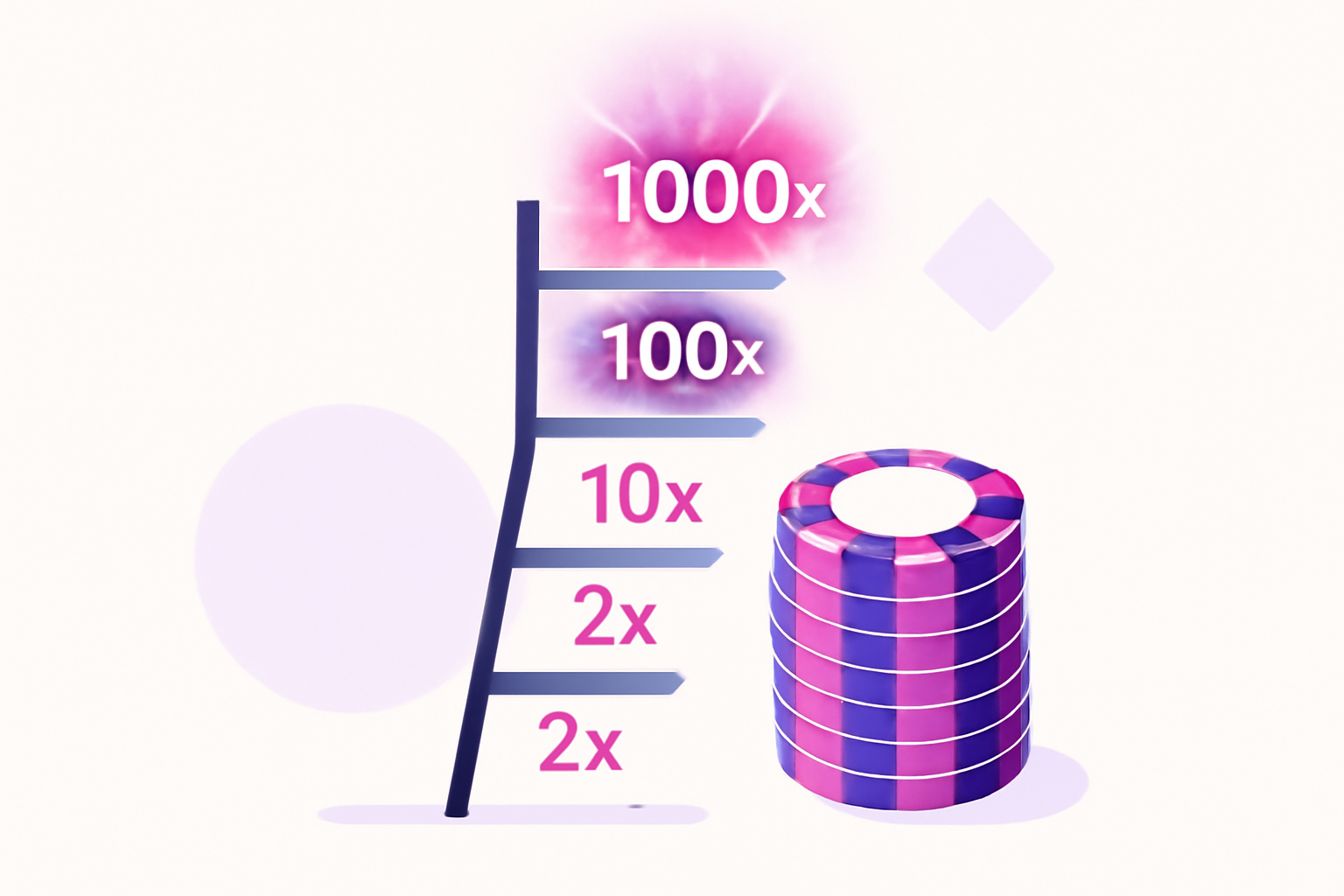
Expresso multipliers: real impact of each level on the jackpot
Discover how each Expresso multiplier level affects your jackpot and expected value. A complete 2026 guide to maximize your Expresso strategy.
Expresso multipliers: real impact of each level on the jackpot
Imagine sitting down for a three-minute poker tournament and walking away with 10,000 times your buy-in. That's the raw appeal of Expresso (also known as Spin & Go or Jackpot Sit & Go) tournaments, where a random multiplicateur spins before the first card is dealt and determines exactly how much money is on the line. Most players chase the top jackpot without ever stopping to ask a critical question: what is each multiplier level actually worth in terms of espérance (expected value), and how does the probability of each outcome shape your real long-run earnings? Understanding this is the difference between playing these formats intelligently and simply gambling.
How the multiplier system works
Before diving into numbers, let's be clear on the mechanics. At the start of every Expresso tournament, a random spin determines a prize pool multiplier that is applied to the combined buy-ins of all three players. If you each pay a €5 buy-in, the base prize pool is €15. A 2x multiplier means the winner takes €30. A 1000x multiplier means someone takes home €15,000.
The key detail most players miss: each multiplier level has a different probability of appearing, and those probabilities are heavily weighted toward the smallest prizes. The entire math of these formats is designed so that the operator maintains an edge while still offering life-changing jackpot potential at the top end.
Common multiplier levels across most platforms look roughly like this:
| Multiplier | Approximate prize pool (€5 buy-in) | Estimated frequency | |---|---|---| | 2x | €30 | ~65–70% of games | | 4x | €60 | ~20–25% of games | | 6x | €90 | ~6–8% of games | | 12x | €180 | ~2–3% of games | | 25x | €375 | ~0.5–1% of games | | 120x | €1,800 | ~0.1% of games | | 1000x+ | €15,000+ | ~0.01% or less |
These numbers are illustrative — exact probabilities vary by platform and are rarely published in full — but the shape of the distribution is consistent everywhere: the jackpot is extremely rare, and the bulk of your sessions will be played for 2x or 4x.
Calculating the real expected value of each multiplier level
This is where espérance becomes your most important analytical tool. Expected value at each level is simply: *probability of that level appearing × value you expect to win from it*.
Let's take a simplified example at a €5 buy-in with a field of three equal-skill players (win rate of 33% each):
2x multiplier (€30 pool, ~67% frequency): Your EV from the prize pool is €30 × 33% = €10. Since you paid €5, your net gain from this level is €5. Multiplied by its frequency: 0.67 × €5 = €3.35 contribution to your overall EV. 25x multiplier (€375 pool, ~0.75% frequency): EV from the pool is €375 × 33% = €123.75. Net gain: €118.75. Contribution: 0.0075 × €118.75 = €0.89 contribution. 1000x multiplier (€15,000 pool, ~0.01% frequency): EV from pool: €15,000 × 33% = €4,950. Net gain: €4,945. Contribution: 0.0001 × €4,945 = €0.49 contribution.
The math is striking. The 2x level, despite being the least glamorous, contributes more to your long-run expected value than the jackpot. This doesn't mean the jackpot is irrelevant — it absolutely matters — but it reframes where you should focus your energy at the table.
Why most players misunderstand their own results
Here's the cognitive trap: because the jackpot multipliers are so memorable and dramatic, players overweight them mentally. You remember the one time the 1000x appeared. You forget the 400 consecutive 2x games you grinded through.
This creates two specific leaks in Expresso strategy:
Leak 1: Ignoring edge in small-multiplier games
Because the 2x and 4x games feel low-stakes and forgettable, many players auto-pilot through them. But since these games represent the overwhelming majority of your volume, any edge you develop or lose in these spots compounds enormously over time. Playing sharp, aggressive poker in a 2x game matters just as much as it would in a high-multiplier spot.
Leak 2: Changing strategy based on multiplier level
Some players open up their ranges dramatically when a big multiplier hits, reasoning that the extra money justifies extra risk. This is partially correct — ICM pressure changes when the multiplier changes the prize structure — but it's easy to take this too far. Against opponents who are also adjusting, the equilibrium strategy doesn't shift as dramatically as you might expect.
If you want to sharpen your decision-making across all multiplier levels, structured study makes a real difference. The drills and concept breakdowns at poker-builder.com/en/training are built specifically to help players identify and fix these kinds of leaks efficiently.
The practical impact on bankroll management
Understanding multiplier frequencies also completely changes how you should think about bankroll management for Expresso formats.
Because roughly 90% of your games will resolve at 2x, 4x, or 6x, your bankroll swings are dominated by your win rate in those common outcomes, not by whether you hit a jackpot. A player who runs poorly at 2x will bleed chips regardless of jackpot luck. A player with a solid edge at the common levels will grow their bankroll steadily even without ever seeing a 1000x.
A reasonable conservative guideline: carry at least 50–75 buy-ins for your chosen stake in Expresso formats. This might sound like a lot, but the high variance introduced by jackpot multipliers — even at low probability — can create significant downswings in the short term. Players who underestimate this frequently drop stakes unnecessarily or bust out entirely.
It also means that moving up stakes should be driven by your demonstrated edge in common-multiplier games, not by a recent jackpot windfall. A single 1000x hit doesn't tell you anything reliable about your win rate.
Actionable takeaways for your Expresso game
Here's what to do differently starting with your next session:
1. Track your results by multiplier level — most tracking software allows this. You want to know your actual win rate at 2x, 4x, and 6x separately, because that's where your real edge (or leak) lives. 2. Stop auto-piloting low-multiplier games. Treat every 2x game as if it were a 25x. The fundamentals — hand selection, push/fold ranges, aggression — should be equally sharp regardless of what the spin showed. 3. Build your push/fold game. Expresso tournaments escalate to push/fold territory quickly. Precise shoving and calling ranges are the single highest-impact skill you can develop. Dedicated range training at poker-builder.com/en/training can accelerate this significantly. 4. Set realistic jackpot expectations. If you play 100 Expressos per week, you can expect a 1000x multiplier roughly once every two years, statistically. Enjoy it if it comes, but do not build your bankroll plan around it. 5. Manage your bankroll conservatively. Fifty buy-ins minimum, moving up only when your common-multiplier win rate justifies it.
The multiplicateur spin is thrilling, but the players who actually profit from Expresso formats long-term are the ones who respect the math of each level and grind their edge in the games everyone else treats as filler. The jackpot is a bonus. Your edge is the foundation.
Ready to improve your game?
Explore our free training courses and interactive tools to level up your poker skills.
Explore free courses →